The Evolution of AI Systems: LLM Workflows, RAG, and Agents
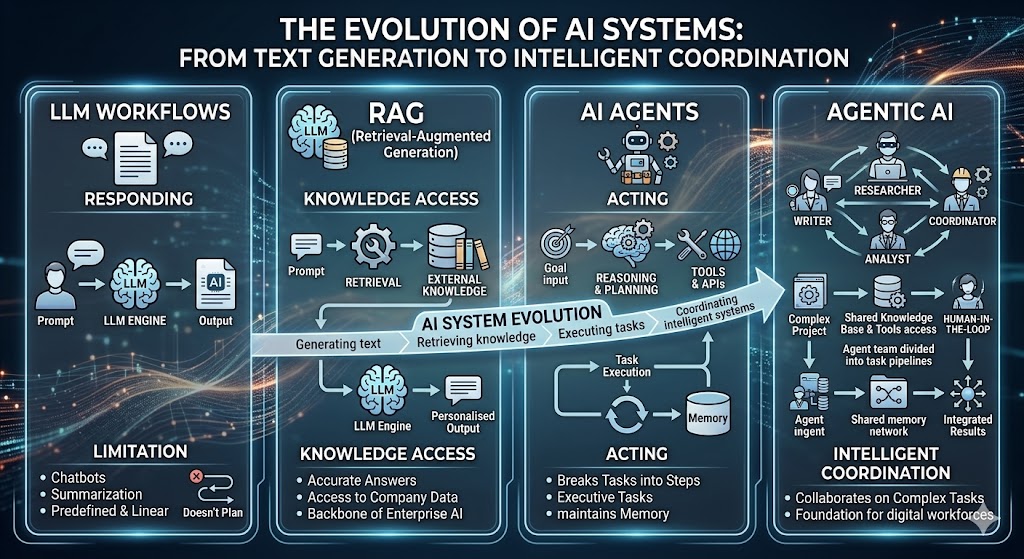

If you talk to the average person about artificial intelligence, they tend to lump every single application, chatbot, and algorithm into one giant, ambiguous bucket. But if you are building, scaling, or implementing these technologies in the real world, you quickly realize that treating all AI as a singular entity is a massive mistake that limits what your software can actually achieve. The landscape has matured rapidly, shifting from basic text generation into an ecosystem driven by execution and intelligent coordination. To truly understand how modern software is being rewritten from the ground up, we have to look past the surface-level hype and analyze the four distinct architectural frameworks shaping the industry today.
At the very foundation of this paradigm shift is the classic LLM workflow, which is the most straightforward, linear setup available. It operates on a predictable blueprint: a user inputs a prompt, the language model processes it, and it spits out a static response based purely on its pre-existing training data. While you can hardcode specific rules to trigger an API or a simple tool along the way, the system itself remains strictly predefined and entirely passive—it doesn't plan ahead, and it doesn't make independent choices. It is the perfect, lightweight solution for standard customer service chatbots, quick text summarization, content generation, and simple, predictable automations where the boundaries of the task are rigid.
However, relying solely on a model's internal memory introduces massive limitations, particularly when it comes to data freshness and accuracy. This exact ceiling is what forced the industry to evolve toward Retrieval-Augmented Generation, or RAG, which connects the core AI model directly to live, external knowledge bases. Instead of guessing or hallucinating when faced with unfamiliar prompts, a RAG architecture converts queries into embeddings, references a dedicated vector database to pull up-to-date documentation, and hands that fresh data to the LLM to form an accurate response. By serving as a reliable bridge to proprietary company data, RAG has rapidly become the trusted backbone of enterprise AI applications worldwide.
The Progression of AI Architecture: Linear Workflows to Grounded Knowledge
When evaluating how to deploy artificial intelligence within an engineering pipeline, the choice between basic LLM workflows and grounded RAG setups usually comes down to data dependency. A standard, linear workflow functions like an open-book exam where the student only relies on what they memorized months ago during their study sessions. It is incredibly fast and efficient for creative content generation or standard formatting tasks, but the second you ask it about a niche technical issue or a real-time event, the system hits an immediate bottleneck. It cannot adapt to what it doesn't know, meaning its utility is tightly locked to its last training cutoff date.
To solve this isolation problem, developers introduce Retrieval-Augmented Generation to ground the model’s reasoning in verifiable, real-time facts. The magic of RAG lies in its data pipeline, which transforms raw company files, internal wikis, and customer databases into a searchable vector index that the AI can scan in milliseconds. When a user interacts with a RAG-backed system, the application pulls contextually relevant text snippets first, dynamically stitching them right into the user's prompt before the LLM even begins drafting an answer. This simple addition completely transforms the user experience, dropping hallucination rates dramatically while offering users highly contextual, deeply accurate insights.
From an architecture and engineering standpoint, moving from a basic workflow to a robust RAG system represents the critical transition from passive text generation to deliberate data retrieval. Companies no longer have to burn massive budgets attempting to fine-tune giant foundation models just to teach them basic company facts. Instead, by treating the LLM as an analytical engine and the vector database as the hard drive, RAG creates a secure, scalable ecosystem that respects data privacy and handles frequent knowledge updates seamlessly. This specific blueprint bridges the gap between raw algorithmic power and practical, day-to-day enterprise utility.
The Shift to Autonomy: Goal-Driven Agents and Multi-Agent Collaboration
The moment an AI system transitions from merely retrieving knowledge to actively executing tasks, we enter the playground of autonomous AI agents. Unlike a standard RAG pipeline that waits for a user to guide every single step, an agent is completely goal-driven, meaning you provide it with an objective, and it figures out the path to get there on its own. It achieves this level of independence by breaking complex goals down into sequential steps, querying databases when it hits an information gap, and maintaining a dynamic internal memory to track its progress. This represents a monumental leap in software engineering, officially shifting the role of artificial intelligence from a passive responder to an active executor.
This operational autonomy becomes exponentially more powerful as you scale up from a single isolated agent into full-scale Agentic AI. In an agentic ecosystem, instead of expecting one master agent to handle an entire complex project, developers build a network of specialized, highly focused agents that collaborate with one another. Picture an autonomous software team where one agent is explicitly configured as a researcher, another acts as an analytical engine, a third writes clean code, and a final coordinator reviews the output—all while maintaining a shared memory network and pulling in human oversight when necessary. This collaborative framework allows the collective system to self-correct, distribute heavy workloads, and solve multi-layered problems that would completely crash a standard linear prompt.
Engineering this layer of intelligent coordination requires a total rethink of traditional software development paradigms. We are no longer writing rigid, deterministic code scripts that follow an unchanging path; instead, we are building fluid, dynamic environments where independent AI models use tools, manage APIs, and chat with each other to complete goals. This shift unlocks an entirely new class of software capability, giving engineering teams the structural tools to build fully autonomous workflows. By mastering multi-agent orchestration, organizations can finally transition away from basic script automation and begin building highly adaptable, self-managing digital systems.
The Future of Software: Redefining Digital Workforces
The architectural evolution cutting across the technology landscape—moving from simple LLM workflows to RAG, then to independent agents, and finally to collaborative agentic teams—is fundamentally rewriting the rules of modern software engineering. We are collectively moving away from an era focused on simple text generation and entering a new dawn of intelligent system coordination. This technological progression means that apps are no longer just static tools designed to sit there and wait for human clicks; they are transforming into proactive digital partners capable of managing entire operational pipelines from start to finish.
As these multi-agent ecosystems mature, they are building the foundation for true AI-driven digital workforces that seamlessly blend human intuition with algorithmic speed. Routine, repetitive tasks like data processing, complex scheduling, and preliminary research are being handed off to autonomous systems that can execute them flawlessly around the clock. This shift doesn't mean humans are being pushed out of the equation entirely; rather, it introduces a highly efficient "human-in-the-loop" model where people step away from manual execution and step into high-level strategic roles, acting as directors, auditors, and creative guides for the AI teams they manage.
Ultimately, the businesses and developers who understand these four core structural frameworks are the ones who will successfully scale their platforms in the coming years. By knowing exactly when to deploy a simple linear workflow versus when to architect a complex multi-agent system, you can build incredibly scalable, resilient software architectures that maximize efficiency without wasting computational resources. The future of software isn't just about making models smarter; it's about building highly cooperative, goal-oriented ecosystems that redefine how work gets done.
Conclusion:
With the shift from text generation to intelligent coordination of a system, it is no longer an option for forward-thinking developers and businesses to master these four architectural frameworks. The ability to truly scale this type of solution is based on the knowledge of when to use a simple linear process and when to use a complex, data-driven multi-agent system. So instead of the superficial fluff, engineering teams can create more resilient, more autonomous digital workforces, that will transform software efficiency and the future of work.


