AI engineer salary - What to expect: Junior to senior in 2026
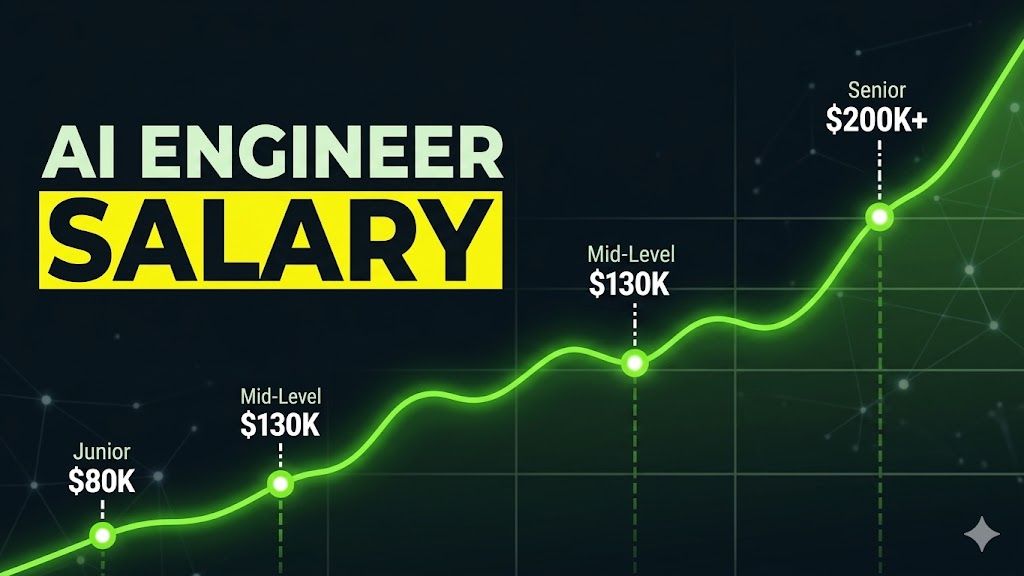

I came across this video breaking down AI engineer salaries and had to pause halfway through because the numbers are actually insane.
According to the latest data, the average AI engineering salary jumped from $156,000 to $206,000 in just one year — a $50,000 increase. On top of that, LinkedIn named AI Engineer the #1 fastest-growing job in the US, with job postings exploding by 143% year-over-year.
Here’s what the salary picture actually looks like right now:
Junior / Entry-Level (0-2 years)
Base salary usually lands between $115k–$150k, with total compensation reaching around $173k in North America.
Important note: “Entry-level” in AI is rarely truly entry-level. Most roles still want some CS/ML background or strong personal projects.
Realistically, breaking into AI engineering at this level usually requires a solid computer science foundation, hands-on projects (especially involving LLMs or RAG), or contributions to open-source repos. Pure beginners without any prior coding or ML exposure will likely need 6–12 months of dedicated learning before becoming competitive for these roles.
Mid-Level (3-5 years)
This seems to be the sweet spot for big growth right now. Base pay ranges from $155k–$220k, and total comp can easily push past $250k. Demand is high, and supply is still low, so companies are paying up.
At this stage, companies expect you to move beyond just experimenting with models. They want engineers who can design and implement production-ready AI features, integrate LLMs into applications, and handle RAG pipelines effectively.
Many mid-level engineers see the fastest salary jumps when they gain strong experience in MLOps, cloud deployment (AWS/GCP/Azure), and scaling AI systems. If you can ship reliable, production-grade solutions, you become extremely valuable in today’s market.
Senior / Lead (7+ years)
Here’s where it gets wild. Base salaries run from $200k to $312k, with total compensation frequently hitting $400k+. At top-tier places like Google (L6) or frontier labs like OpenAI, the best engineers are seeing offers north of $600k–$900k.
The video also highlights what actually moves the needle on pay: specialization (especially LLMs, generative AI, and RAG), location (Bay Area, Seattle, NYC pay the most), and most importantly — deployment experience.
The biggest gap companies complain about isn’t theoretical AI knowledge. They need engineers who can take models and actually ship them into production at scale. Python, MLOps, cloud infrastructure, and real system-building skills matter way more than just another Kaggle notebook.
My honest take: Yes, the money is crazy attractive. But this isn’t a “learn AI in 3 months and get rich” situation. It usually takes 1–3 years of serious, consistent effort to reach the levels where these top salaries kick in. The video does a good job reminding people that the numbers shown are skewed toward high-paying markets and companies.
If you’re thinking about pivoting into AI engineering in 2026, treat it like a real engineering discipline — focus on building and deploying production systems, not just playing with prompts.
The opportunity is massive, but only for those willing to put in the work.
https://www.youtube.com/watch?v=eTBSF411yQ4


