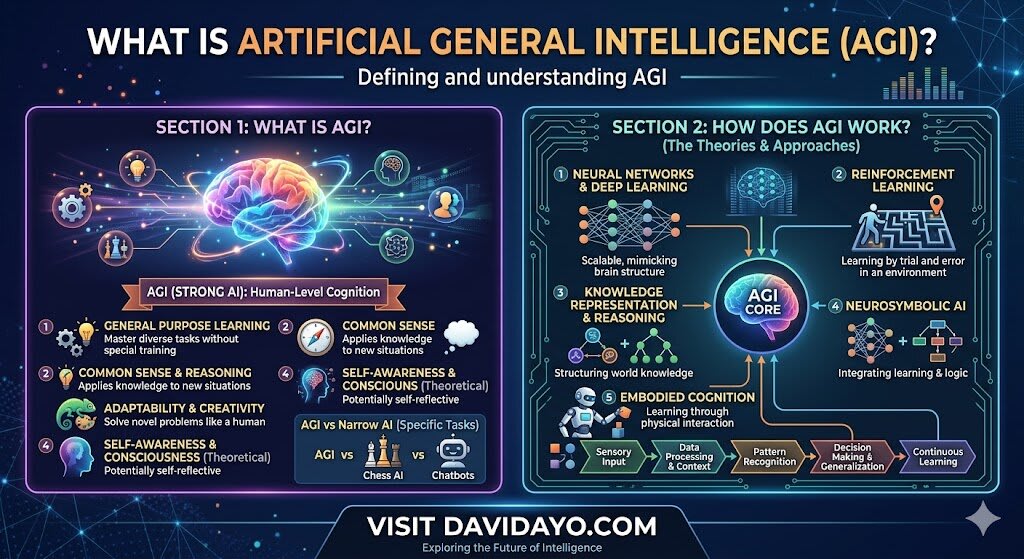
Defining and understanding AGI
Section 1: What is AGI?
AGI (Strong AI): Human-Level Cognition
- General Purpose Learning: Master diverse tasks without special training.
- Common Sense & Reasoning: Applies knowledge to new situations.
- Adaptability & Creativity: Solve novel problems like a human.
- Self-Awareness & Consciousness (Theoretical): Potentially self-reflective.
AGI vs. Narrow AI (Specific Tasks)
AGI vs. Chess AI vs. Chatbots
Section 2: How Does AGI Work?
The AGI Core Architecture
- Neural Networks & Deep Learning: Scalable, mimicking biological brain structures.
- Reinforcement Learning: Learning by trial and error within a dynamic environment.
- Knowledge Representation & Reasoning: Structuring deep world knowledge.
- Neurosymbolic AI: Integrating machine learning data patterns with symbolic logic.
- Embodied Cognition: Learning and interacting through physical, real-world context.
The AGI Processing Pipeline
- Sensory Input
- Data Processing & Context
- Pattern Recognition
- Decision Making & Generalization
- Continuous Learning
If you have used modern AI tools, you have experienced Narrow AI—systems trained to handle specific tasks like writing code, generating images, or analyzing datasets. Artificial General Intelligence, or AGI, represents the next major leap: a theoretical form of AI that possesses human-level intellect. Unlike today’s specialized programs, an AGI system wouldn’t need separate training for every new chore; it could think abstractly, apply common sense, and master completely unfamiliar skills all on its own.
Key characteristics of AGI include
- Generalization ability: AGI could apply knowledge and skills learned in one area to completely new and unseen situations.
- Autonomous learning: It'd be able to acquire new skills and knowledge through experience without needing constant reprogramming or updates from humans.
- Adaptability: AGI would handle new or unexpected situations by leveraging its existing knowledge.
- Human-like intelligence: This includes the capacity for abstract reasoning, understanding meaning, and operating effectively in open-ended environments.
Understanding how AGI might actually work means looking past basic pattern recognition and moving toward complex, human-like cognition. Instead of just predicting the next word in a sentence or identifying objects in a photo, AGI requires an underlying system capable of deep reasoning, autonomous problem-solving, and transferring knowledge from one domain to another. Engineers are exploring a mix of advanced deep learning networks, neurosymbolic AI—which blends logic with data processing—and self-reflective learning loops to build this flexible cognitive foundation.
What Makes Artificial General Intelligence Different From Narrow AI?
What Makes AGI Different From Narrow AI?
To understand the future of technology, it helps to look at the artificial intelligence we use every day. Current platforms—from facial recognition software and autonomous driving assistants to advanced large language models—are examples of Narrow AI (or Weak AI). These systems are incredibly powerful, but they are specialists designed to operate within strict boundaries. A chess-playing computer cannot write code, and an image generator cannot analyze a financial spreadsheet; they only excel at the specific datasets and parameters they were trained on.
Artificial General Intelligence (AGI) breaks out of these functional silos by introducing the concept of cross-domain adaptability. Instead of requiring a brand-new training cycle for every unique task, an AGI system can transfer knowledge learned in one context to solve an entirely unrelated problem. Think of it like a human learning to drive a car: you don’t need to completely relearn how physics, steering, or braking work just because you switch from a sedan to an SUV. AGI aims to mimic this exact type of mental flexibility, combining common sense, abstract reasoning, and conceptual understanding.
Key Takeaway: Narrow AI matches or beats human capabilities in one isolated skill, while AGI aims to match human intellect across virtually any intellectual task.
The Core Tech Behind How Artificial General Intelligence Might Work
The Core Tech Behind How AGI Might Work
Building a machine that can think like a human requires moving past simple data pattern matching. While today's AI models are incredibly fast at processing text or images, true general intelligence requires an underlying architecture that can reason, plan, and understand the physical world. Tech teams are currently working to bridge this gap by combining several distinct software engineering and machine learning paradigms into a single, cohesive ecosystem.
To achieve this level of flexible, human-like cognition, researchers are actively developing and combining a few foundational tech pillars:
- Neurosymbolic AI: This approach blends the data-driven pattern recognition of deep learning networks with the rule-based logic of traditional computer science. By combining these two systems, the software can make intuitive leaps while still following strict, common-sense reasoning and mathematical logic.
- Multimodal Processing Ecosystems: Instead of processing text, video, or audio in isolated silos, true general intelligence relies on unified frameworks. The system processes multiple data types simultaneously—perceiving the world through visual, textual, and sensory inputs all at once to build a complete model of context.
- Advanced Transfer Learning & RAG: Today's systems use Retrieval-Augmented Generation (RAG) to look up external documents, but an AGI foundation takes this further. It uses highly dynamic memory loops to instantly apply knowledge gained in one industry or task to a completely unfamiliar problem without needing a full code rewrite or a new training cycle.
Why Having a Physical Body Helps Artificial General Intelligence Learn
Most people view artificial intelligence as a collection of algorithms existing purely in the cloud, processing code and text files on distant servers. However, many computer scientists argue that true general intelligence cannot be achieved through data screens alone. This perspective highlights the importance of embodied cognition—the theory that a mind requires a physical form to truly interact with, experience, and understand the real world. Without a physical body, software lacks the sensory feedback loops that humans rely on from infancy to build genuine common sense.
When an AI is confined to text or static images, it only learns representation; it doesn't learn consequence. Giving a system a physical presence—whether through robotics, advanced spatial sensors, or highly detailed interactive environments—changes how it processes information. A physical body forces the software to learn critical real-world concepts naturally, including:
- Spatial Awareness and Physics: Understanding gravity, friction, and object permanence by physically moving through a three-dimensional space.
- Cause and Effect: Learning that an action results in an immediate physical reaction, which builds a much deeper framework for logical reasoning than reading descriptions in a manual.
- Real-Time Adaptation: Dealing with unpredictable, messy environments—like navigating a crowded room or handling fragile objects—which forces the system to troubleshoot on the fly.
Ultimately, a physical framework transforms how software retains and applies knowledge. Instead of relying on human engineers to hand-code millions of rules for every possible scenario, an embodied system learns autonomously through trial, error, and physical interaction. This constant loop of sensory input and physical output provides the raw, practical context needed to transition an algorithm from a highly advanced data calculator into a truly flexible, self-learning intellect.
Main Features of a True AGI System
If we look past the sci-fi hype, a true general intelligence system won't just be an upgraded version of the chatbots or image generators we use today. Instead, it will be defined by its ability to handle completely unpredictable scenarios without human intervention. To move from specialized software to true human-level intellect, an autonomous framework must possess a core set of features that allow it to reason, adapt, and build its own understanding of the world from scratch.
While today's platforms excel at processing massive datasets to find patterns, a genuine general intelligence engine relies on several interconnected cognitive capabilities to function effectively:
- Autonomous Problem-Solving: The system doesn't rely on pre-programmed rules or prompt engineering to handle a task. When faced with an entirely new challenge, it can figure out its own step-by-step strategy to achieve the goal.
- Cross-Domain Knowledge Transfer: Much like a human can take lessons learned in sports and apply them to business management, this software can instantly take a concept learned in one industry—like advanced physics—and use it to solve a problem in an unrelated field like economics.
- Continuous, Self-Directed Learning: Instead of requiring engineers to run a massive data retraining cycle, the system learns dynamically from its everyday environment, retains information over time, and corrects its own internal logic loops when it makes a mistake.
Ultimately, the most critical feature of a next-generation cognitive framework is true contextual awareness. It moves software away from simply guessing the next logical word or pixel based on static mathematical probabilities. Instead, it allows the application to understand the "why" behind an instruction, giving it the common sense needed to serve as a reliable, scalable partner in mission-critical environments.
Conclusion: The Road to True Cognitive Software
The journey toward artificial general intelligence represents a massive shift in how we build and interact with technology. We are steadily moving away from rigid, specialized tools that require constant human oversight and stepping into an era of highly adaptive, self-learning frameworks. While true human-level intellect in machines remains an ongoing engineering challenge, the foundational building blocks—like multimodal processing, neurosymbolic reasoning, and embodied learning—are rapidly transforming the software landscape right before our eyes.
For forward-thinking developers and business leaders, tracking this evolution isn’t just about waiting for a sci-fi future; it’s about understanding how to build more resilient digital foundations today. By focusing on flexible system architectures, secure data integrations, and smart automation, you ensure your current applications are ready to scale alongside these cognitive breakthroughs.
The Bottom Line: True general intelligence isn't just about massive scale—it's about genuine adaptability. Preparing your digital infrastructure for this shift means focusing on smart, modular, and deeply integrated software solutions that can grow with your business.
Frequently asked questions about AGI
How does AGI differ from traditional AI?
Artificial Intelligence (AI) is an umbrella term that encompasses any software or system capable of executing tasks, making decisions, or calculating predictions without direct human intervention—ranging from basic non-player character (NPC) behavior in video games to advanced, modern Large Language Models.
Artificial General Intelligence (AGI), however, is a highly specific subset. It refers to a theoretical system that possesses autonomous, human-level (or superior) cognitive faculties, allowing it to adapt, learn, and cross-functionally generalize across any intellectual task without needing specialized retraining.
Are Large Language Models (LLMs) capable of achieving AGI?
This remains one of the most heavily debated topics in computer science. While frontier models exhibit remarkable linguistic fluency, a growing body of machine learning research suggests that simply scaling the parameters or compute of standard LLMs will not lead to true AGI. Even deep reasoning models face fundamental architecture limits—such as a lack of physical grounding, casual reasoning flaws, and synthetic data degradation—that currently prevent them from achieving authentic, open-ended generalization.
What is the difference between AGI and Artificial Superintelligence (ASI)?
Think of AGI as the baseline foundational requirement for Artificial Superintelligence (ASI), though they represent entirely different tiers of capability.
-
AGI is achieved the moment a system matches the intellectual depth, adaptability, and problem-solving skills of an average human professional.
-
ASI represents the stage beyond that: an intelligence explosion where the system surpasses the collective cognitive capacity of the entire human race combined across every conceivable discipline, from abstract mathematics to creative execution.
In short, an AI that performs exactly like an ordinary human is AGI, but it is not ASI.