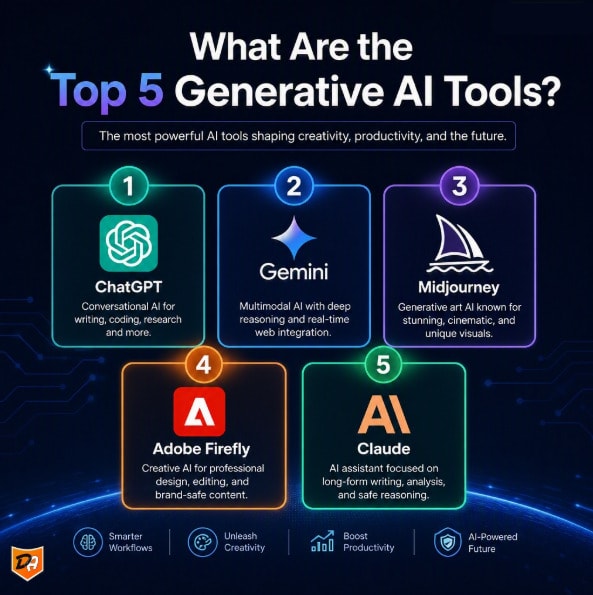
I think I can say the top five generative AI tools changing the way we work, create, and build in 2026 are ChatGPT, Claude, Midjourney, Runway, and GitHub Copilot.
Instead of treating these tools like rigid calculators or complex tech experiments, it helps to think of them as specialized digital partners. Generative AI has evolved past simple text shortcuts; it can now reason through messy problems, create Hollywood-grade video clips, and write clean software code. Here is a practical, down-to-earth breakdown of the five heavy hitters dominating the landscape, what they actually do best, and how to pick the right one for your specific goals.
The Big Five Generative AI Tools Compared
| Tool | Core Specialization | Best For | Typical Workflow Output |
|---|---|---|---|
| ChatGPT | General Purpose & Logic | Universal assistant tasks | Text, data analysis, deep research |
| Claude | Advanced Writing & Nuance | Complex documents & code | Natural essays, long reports, full code blocks |
| Midjourney | Hyper-Realistic Images | Creative visual design | High-end concept art, UI layouts, graphics |
| Runway | AI Video Generation | Video editing & production | B-roll footage, cinematic video, motion art |
| GitHub Copilot | Software Engineering | Context-aware programming | Boilerplate code, debugging, full functions |
A Deep Understanding: How the Top 5 Tools Actually Work
1. ChatGPT (OpenAI) — The All-Rounder
If you need an immediate brainstorming partner, a quick summary of a long research paper, or a sounding board for business ideas, OpenAI's ChatGPT remains the gold standard for daily multitasking.
- The Human Reality: It feels like talking to a highly knowledgeable colleague who knows a little bit about everything. It handles live web research, analyzes uploaded spreadsheets, and builds custom mini-tools (Custom GPTs) to automate your specific routines.
- Where It Shines: Quick problem-solving, structured outlines, and processing random, unorganized thoughts into tidy summaries.
2. Claude (Anthropic) — The Master Wordsmith and Thinker
When you need writing that actually sounds like it came from a human—rather than a predictable machine—Anthropic's Claude is the clear favorite.
- The Human Reality: Claude has an exceptional grasp of tone, emotional nuance, and long-form logic. If you paste a massive 50-page document into Claude, it won't just skim it; it deeply understands the underlying context and can write highly sophisticated, cohesive responses without losing its train of thought.
- Where It Shines: Drafting long articles, heavy legal or financial analysis, and writing complex blocks of clean, human-readable code.
3. Midjourney — The Visionary Artist
For generating breathtaking visuals from raw text, Midjourney stands completely unparalleled in image quality.
- The Human Reality: It bypasses the flat, artificial look typical of basic image generators, delivering cinematic textures, rich lighting, and believable human expressions. Instead of struggling with stock photos, creators use it to turn abstract ideas into concrete visual mockups.
- Where It Shines: Creating stunning concept art, website user interface (UI) inspirations, marketing graphics, and architectural visualizations.
4. Runway — The Digital Film Studio
Video production used to require massive budgets, complex cameras, and days of editing. Runway changes that entirely by letting you generate and edit video clips using conversational English.
- The Human Reality: Runway allows you to generate cinematic B-roll, animate still pictures, or seamlessly erase background objects from video clips with a few clicks. It serves as a massive shortcut for creators who need high-quality motion graphics without a physical camera crew.
- Where It Shines: Creating social media video backgrounds, generating quick video prototypes, storyboarding films, and automated video editing.
5. GitHub Copilot — The Engineering Co-Pilot
Software engineering is shifting from manual line-by-line typing to architectural design. GitHub Copilot sits directly inside a developer's workspace, guessing what they want to build next and writing the code for them in real time.
- The Human Reality: It acts like a brilliant apprentice engineer sitting right next to you. It handles the boring, repetitive parts of programming (like setting up basic files or repetitive data lists), freeing up human developers to focus on creative problem-solving and app logic.
- Where It Shines: Speeding up app development workflows, debugging broken software code, and translating a project from one programming language to another.
What is Generative AI & How Does It Work?
Generative AI is a branch of artificial intelligence that creates entirely new content—including text, images, audio, and code—by recognizing complex patterns in existing human data. Unlike traditional "analytical" AI, which merely categorizes or filters information (like flagging credit card fraud or ranking search results), generative AI acts as a digital creator. It leverages advanced mathematical frameworks to predict, synthesize, and assemble novel outputs based on the collective knowledge it has absorbed.
The Evolution: From Analyzing to Creating
To understand generative AI, it helps to contrast it with the systems we have lived with for over a decade.
- Analytical AI (The Critic): You feed it a million photos of cats. It learns the specific geometry of whiskers and ears. When you show it a new photo, it can tell you with 99% accuracy: "This is a cat."
- Generative AI (The Artist): You feed it the same million photos. Instead of just learning to recognize a cat, it maps the underlying essence of "cat-ness." When you ask, it draws a completely original cat sitting on a neon spaceship—an image that has never existed before.
How Generative AI Works Under the Hood
Generative AI does not possess a human mind, consciousness, or lived experiences. Instead, it relies on complex statistics, neural networks, and massive computing architecture. The magic happens in a three-part process:
1. Tokenization and Vector Mapping
Computers cannot read words or look at brushstrokes the way humans do. When an AI receives data, it breaks it down into tokens (fragments of words, characters, or pixels).
These tokens are converted into numbers called vectors. The AI places these vectors into a massive, multi-dimensional mathematical landscape called an embedding space. In this space, words with similar meanings or contexts (like "king" and "queen," or "coffee" and "morning") are physically grouped close together.
2. The Transformer Architecture and Self-Attention
The true breakthrough of modern generative AI is the Transformer network. Older models read sentences one word at a time, often forgetting the beginning of a paragraph by the time they reached the end.
Transformers use a mechanism called self-attention. This allows the mathematical system to look at every single word in a prompt simultaneously and calculate how they relate to one another. For example, in the sentence "The bank of the river was muddy," the system uses self-attention to link "bank" to "river" rather than a financial institution.
3. Probability and Next-Token Prediction
When you type a prompt, the AI does not copy and paste from a database. It runs a massive calculation to ask: "Based on everything humans have ever written, what is the most statistically logical next token?"
It generates output one fragment at a time, continuously recalculating the probabilities to ensure the response remains coherent, contextual, and stylistically aligned with your request.
[User Prompt] ➔ [Tokenization] ➔ [Transformer/Self-Attention] ➔ [Probability Match] ➔ [Generated Content]The Four Pillars of Generative Models
Different types of content require different underlying architectures. The modern landscape is driven by four primary models:
| Model Type | Primary Superpower | Common Real-World Example |
|---|---|---|
| Transformers | Mastering human language, logic, and code structures | OpenAI ChatGPT |
| Diffusion Models | Generating crisp, highly detailed images from pure noise | Midjourney / DALL-E 3 |
| GANs (Adversarial) | Pitting two networks against each other for realism | Deepfake tech / Video generation |
| VAEs (Autoencoders) | Compressing data to find core structural patterns | Signal cleaning / Structural design |
The Human Element: Training and Fine-Tuning
Raw mathematical prediction can sometimes result in chaotic, unhelpful, or offensive text. To bridge the gap between machine probability and human expectation, engineers use a process called Reinforcement Learning from Human Feedback (RLHF).
Human trainers review thousands of AI responses, ranking the best, safest, and most helpful answers. The AI adapts its internal parameters based on this feedback. This training is what allows the machine to match the tone, nuance, and structural expectations of human conversation.
The Limitations: A Mirror, Not a Mind
While generative AI can mimic creativity, it operates with significant boundaries:
- Hallucinations: Because the AI operates on mathematical probability rather than a true understanding of objective truth, it can confidently generate false facts, fake citations, or incorrect data.
- Lack of Lived Experience: AI can write a poem about heartbreak by analyzing the structural patterns of thousands of existing poems. However, it does not understand the emotional weight of grief, joy, or consciousness.
- Data Biases: If the internet data used to train the model contains cultural, racial, or gender biases, the AI will mirror and amplify those exact biases in its creations.
Ultimately, generative AI functions best as a collaborative partner. It acts as a powerful amplifier for human productivity, taking care of the initial, repetitive stages of creation so humans can focus on critical editing, strategic direction, and emotional depth.
Top Generative AI Tools and Software for 2026
The generative AI landscape has moved past the era of novelty chatbots and basic text generation. In 2026, the technology has transitioned into a highly specialized ecosystem driven by agentic workflows, on-device intelligence, and multimodal reasoning. This shift means tools no longer just respond to prompts; they execute complex, multi-step projects independently while integrating into professional workflows. Understanding this year's software landscape requires looking at specialized engines that deliver precise utility across writing, development, research, and media creation.
1. Advanced Search and Research Engines
Modern research platforms have moved from standard search indexing to synthesis and deep verification. They act as analytical partners that map information spaces rather than simple link providers.
Perplexity
- Core Focus: Sourced knowledge discovery and live web indexing.
- How It Works: Perplexity functions as an answer engine that cross-references live digital footprints. Its Deep Research feature avoids typical conversational fluff, compiling structured, multi-perspective reports while citing verifiable, peer-reviewed sources directly.
- Best Used For: Eliminating manual tab-browsing and verifying complex, real-time facts.
Google NotebookLM
- Core Focus: Private source synthesis and document interaction.
- How It Works: Users upload a centralized corpus of data—such as PDFs, research papers, or internal documentation. NotebookLM builds an isolated, highly accurate knowledge environment. It allows teams to converse with their files, generate conceptual mind maps, and transform dense text into structured audio summaries or custom podcasts.
- Best Used For: Organizing heavy research loads without data leakage.
2. Long-Form Writing and Content Refinement
Text generators in 2026 prioritize structural logic, contextual memory, and human-sounding prose over robotic, high-volume output.
Claude (Anthropic)
- Core Focus: Complex instruction-following and nuanced long-form drafts.
- How It Works: Known for its deep context windows and natural narrative cadence, Claude excels at executing multi-layered editorial structures. Through its specialized workflow capabilities, it tracks complex brand guidelines across hundreds of pages without losing stylistic consistency.
- Best Used For: Technical documentation, long-form educational content, and structured messaging.
Phrasly
- Core Focus: Content humanization and structural optimization.
- How It Works: Moving beyond basic synonym replacement, Phrasly analyzes the rhythmic and structural markers that make text feel machine-generated. It alters sentence length variation, colloquial phrasing, and paragraph pacing to optimize drafts for human readability and audience engagement.
- Best Used For: Refining rough AI drafts into engaging, polished articles.
3. Visual and Multimodal Production
Visual creation tools have advanced into collaborative digital studios, allowing precise manipulation and commercial-grade generation across multiple mediums.
Adobe Firefly
- Core Focus: Commercially safe graphic generation and asset editing.
- How It Works: Firefly is embedded directly into enterprise design suites to handle generative fill, infinite canvas brainstorming, and asset remixing. Because it is trained on licensed and public domain assets, it provides a legally secure framework for commercial projects.
- Best Used For: Graphic design, brand assets, and marketing material production.
Runway (Gen-3 Ecosystem)
- Core Focus: Cinematic video generation and physical motion consistency.
- How It Works: Runway leverages advanced physics-informed models to generate video clips from text prompts or static images. Its tools allow fine-grained control over motion tracking, camera camera placement, and style transfers, reducing the barrier to premium video production.
- Best Used For: High-end marketing campaigns, conceptual video storyboards, and digital art.
4. Architectural Summary: Selecting Your Stack
| Tool Category | Key Platforms | Core Practical Strength | Optimal Environment |
|---|---|---|---|
| Research & Synthesis | Perplexity, NotebookLM | Deep factual verification; private file mapping. | Data heavy discovery & synthesis. |
| Editorial & Writing | Claude, Phrasly | Structural flow; highly humanized narrative style. | Complex blogs, essays, and guides. |
| Creative Media | Adobe Firefly, Runway | Legal compliance; high-fidelity motion graphics. | Commercial design & production studios. |
The defining strategy for 2026 is modular integration. Instead of searching for a singular, all-in-one AI tool, modern creators build a custom pipelines—using engines like Perplexity to build a factual foundation, Claude to construct deep narratives, and platforms like Phrasly or Firefly to polish the final presentation for human readers.
Generative AI for Image and Video Generation
The landscape of generative media has fundamentally shifted. The industry has moved past the era of digital hallucinations—where AI-generated videos were defined by melting faces and images suffered from the notorious "six-finger" problem.
The generative image and video ecosystem is defined by spatial intelligence, physical consistency, and granular director-level control. AI tools are no longer just random asset generators; they are collaborative, multi-modal studios capable of understanding light, weight, and camera mechanics.
1. The Engineering Shift: From Diffusion to World Models
To understand why modern generative media looks remarkably lifelike, it helps to understand the architectural shift behind the software:
- The Old Way (Basic Diffusion): Early image generators worked like a sculptor clearing away static. They started with random digital noise and chipped it away until the pixels resembled a prompt. However, these models lacked a true understanding of the real world. They didn’t know that an object hidden behind a tree should reappear on the other side, or that heavy glass falls faster than a feather.
- The Modern Way (Diffusion Transformers & World Models): Current generation engines combine Diffusion with Transformers (DiT). Instead of treating video as a sequence of flat, disconnected frames, these systems build a temporary 3D understanding of the space. They simulate gravity, momentum, lighting reflection, and object permanence. If a character walks off-screen left, the AI remembers their physical attributes when the virtual camera pans back to find them.
2. The Core Landscape: Leading Engines and Their Utility
The current ecosystem is highly specialized. Creative professionals choose specific platforms based on their unique workflows, safety guardrails, and aesthetic needs.
Midjourney
- The Narrative Aesthetic: Midjourney remains the industry standard for illustrative depth, complex texture mapping, and cinematic atmosphere.
- The Human Touch: It excels at understanding historical art styles, complex editorial lighting (such as chiaroscuro or volumetric fog), and micro-expressions on human faces.
- Practical Strength: Its deeply integrated pan, zoom, and regional vary tools allow artists to use a single image as an expansive canvas, changing specific details without altering the core style.
OpenAI Sora & Runway (Gen-3 Alpha)
- The Cinematic Directors: These platforms represent the peak of generative video physics. They are built specifically to handle complex cinematic choreography.
- The Human Touch: Instead of generating random motion, these engines allow users to prompt specific camera movements—such as a slow tracking shot, a high-angle crane movement, or a tight rack focus. They accurately simulate how light filters through moving water or how fabric folds and ripples when a character runs.
- Practical Strength: Rapid prototyping for advertising agencies and film production teams. Directors can generate high-fidelity pre-visualization (pre-vis) storyboards in minutes rather than weeks.
Luma Dream Machine & Kling AI
- The Real-Time Animators: These tools have democratized high-speed, action-oriented video generation. They focus heavily on maintaining structural integrity during fast panning shots and sudden physical movements.
- The Human Touch: They are highly responsive to prompt changes that dictate speed, force, and emotional expression. If a prompt demands a character transition from joy to sorrow, the facial micro-muscles shift with realistic anatomical pacing.
- Practical Strength: Rapid content creation for social media, immersive web design, and dynamic digital marketing campaigns.
Adobe Firefly
- The Commercial Guardrail: Firefly is built explicitly for enterprise environments where legal safety and copyright compliance are non-negotiable.
- The Human Touch: Integrated seamlessly into tools like Photoshop and Illustrator, Firefly behaves like an invisible digital assistant. It focuses on clean, precise compositing, allowing human designers to seamlessly replace backgrounds or extend canvases with a single click.
- Practical Strength: It is trained entirely on licensed content and public domain images. This guarantees that corporate marketing departments can deploy generated assets globally without fear of intellectual property litigation.
3. Structural Comparison: Choosing Your Creative Engine
| Tool | Core Creative Specialty | Best Production Environment | Legal & Copyright Status |
|---|---|---|---|
| Midjourney | Hyper-stylized images & conceptual art | Pre-production & mood boarding | Open/Community training base |
| Runway / Sora | Physics-consistent, cinematic video | Commercials & high-end storyboards | Proprietary/Enterprise datasets |
| Kling / Luma | Fast action & high-motion video generation | Social media & agile content creation | Proprietary web-scale datasets |
| Adobe Firefly | Compliant graphic design & editing | Corporate branding & commercial print | 100% commercially safe & indemnified |
4. The Human Element: Why Prompt Engineering Is Dead
The concept of "prompt engineering"—the idea that you need a secret sequence of magical keywords to get a good image—is obsolete.
Modern media generators use advanced multimodal language models as their front ends. They don't just read your words literally; they interpret your creative intent. If you type "a gritty detective in the rain," the underlying system automatically translates that into technical cinematic terms, calculating the necessary rim lighting, lens focal length, and asphalt reflections to achieve that mood.
The real human skill has shifted from technical prompting to editorial curation. The value of a human creator no longer lies in pushing the button; it lies in choosing the frame, adjusting the emotional pacing, maintaining narrative cohesion across scenes, and knowing when a generated asset looks genuinely human versus artificially perfect.
Conclusion: Building Your AI Workflow
Generative AI in 2026 isn't about finding one tool that does it all—it's about combining specialized strengths to boost your productivity. Whether you're using ChatGPT for fast problem-solving, Claude for nuanced writing, Midjourney for visual assets, Runway for motion graphics, or GitHub Copilot for clean code, the magic happens in how you direct these tools. As AI models become faster and more capable, the real human advantage comes down to critical thinking, editorial judgement, and clear creative vision.
Frequently Asked Questions
1. What is the difference between AI and generative AI
Generative AI is a specific subset of Artificial Intelligence (AI); this means all generative AI is AI, but not all AI is generative. The primary distinction lies in their purpose: traditional AI analyzes data to make decisions or predictions, while generative AI uses data to create entirely new content.
| Feature | Traditional AI | Generative AI |
|---|---|---|
| Primary Goal | Analyze, classify, and predict. | Create brand-new content. |
| Output Type | Numeric forecasts, labels, or true/false decisions. | Text, images, audio, video, or code. |
| Core Function | "The Editor"—refines and sorts existing data. | "The Storyteller"—invents new data patterns. |
| User Input | Structured data, parameters, or rules. | Natural language prompts. |
| Common Examples | Financial fraud alerts, spam filters, Netflix recommendations. | ChatGPT, Midjourney, GitHub Copilot. |
2. Is ChatGPT a generative AI
Yes, ChatGPT is a generative AI.
It belongs to this category because it does not just analyze or classify existing text, but actively creates entirely new content based on the prompt you give it. Why ChatGPT Is Generative AI:
- Content creation: It writes unique text, generates software code, drafts emails, and builds stories from scratch.
- Pattern replication: It uses a Large Language Model (LLM) to learn the statistical patterns of human language and predict the next most logical words.
- Prompt-driven: It relies on natural language instructions rather than strict coding commands to decide what to create next.
3. What is meant by generative AI
Generative AI is a type of artificial intelligence that can create brand-new content.
Unlike traditional AI that only analyzes, filters, or predicts based on existing data, generative AI uses machine learning models to study massive datasets, learn their underlying patterns, and then generate original text, images, video, audio, or computer code that mimics human creation. How Generative AI Works:
- Data Training: The AI studies billions of examples of human-made content (like books, photos, or songs).
- Pattern Learning: It learns the deep structures, styles, grammar, and relationships within that data.
- Probability Mapping: When you give it a prompt, it calculates the highest statistical probabilities to assemble something entirely unique from scratch.