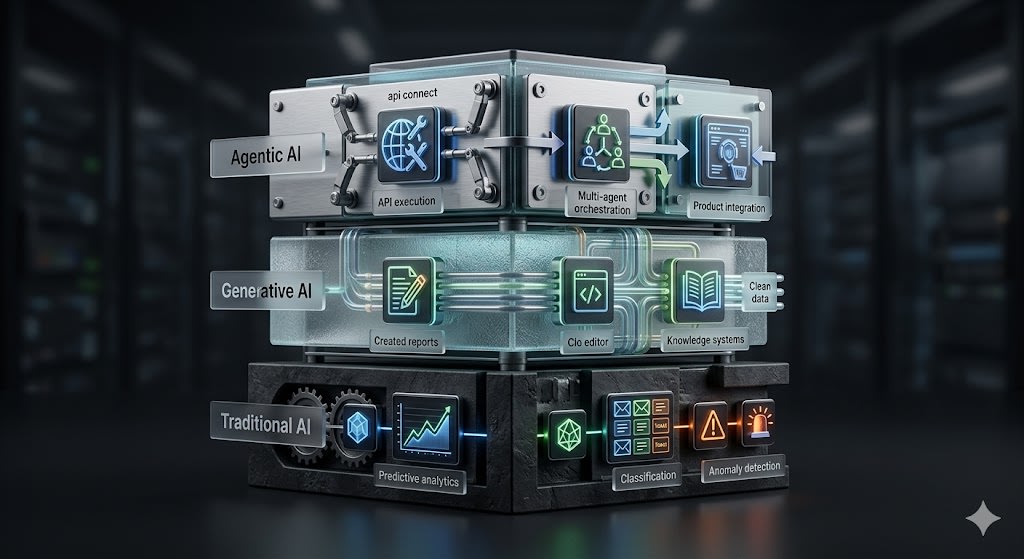
Everyone wants to jump straight into Agentic AI, but the real foundation still starts with Traditional AI. While the excitement around autonomous agents is understandable, building a strong AI strategy requires understanding the full progression. Here’s a simple way to understand the three main types of AI and why each layer matters.
- Traditional AI.
- Generative AI.
- Agentic AI.
The three main categories are Traditional AI, Generative AI, and Agentic AI. Each one serves a very different purpose and solves different kinds of problems. Traditional AI forms the reliable base, Generative AI brings creativity and content creation, while Agentic AI focuses on goal-oriented autonomy. Knowing how they differ is essential before deciding where to invest your time and resources.
Knowing how these three types differ — and how they build upon one another — is essential before deciding where to invest your time and resources. Starting with a solid understanding of Traditional AI helps create a much stronger foundation for adopting Generative and Agentic systems later.
Traditional AI
The Workhorse of Enterprise Automation
Before the hype cycle shifted to chatbots, businesses were already quietly driving massive efficiency gains using Traditional AI. This is the analytics engine many companies already have running in production today. While it doesn't draft poetry or design graphics, it excels at something far more critical to a company’s bottom line: processing massive streams of historical data to uncover hidden operational truths.
From Raw Data to Measurable Certainty
→ Predictive analytics forecasts customer behaviour, demand patterns, and business risk.
→ Classification systems sort emails, transactions, support tickets, and internal requests.
→ Anomaly detection spots fraud, system failures, security issues, and unusual patterns.
The Clear Path to High-Return ROI
Why it matters:
↳ Traditional AI helps the business understand what is happening.
↳ It turns messy, chaotic activity into distinct patterns leaders can measure.
↳ Because its boundaries are strict, it often has clearer ROI than the newer AI tools.
Generative AI
The Catalyst for Workspace Velocity
Generative AI is the technology that forced its way into the mainstream and fundamentally changed how teams view productivity. This is the specific AI layer that most teams started testing immediately after the launch of ChatGPT. By instantly shifting the baseline speed of daily operations, this layer fundamentally changes how companies approach knowledge and creation.
Accelerating Workloads with Semantic Context
→ Content generation creates drafts, reports, emails, code, images, and documents.
→ Workflow automation plugs AI into daily tasks like notes, triage, and data cleaning.
→ Knowledge systems use company data so AI can answer business questions.
The Fragility of Unstructured Inputs
Where it helps:
↳ Generative AI speeds up execution on creative and administrative work that used to take hours.
↳ It works at its absolute best when the underlying data is clean and organised.
↳ Conversely, it breaks quickly when teams feed it messy files or vague context.
Agentic AI
The New Frontier of Execution
We are currently living through the transition from AI that assists to AI that executes. This is the cutting-edge category everyone is talking about now, representing a shift away from passive text generation and toward active, autonomous operation. Instead of waiting for human prompts, these systems are built to accomplish goals independently.
The Complex Dynamics of Autonomous Collaboration
→ AI agents use APIs, tools, and external systems to execute complex tasks.
→ Multi-agent orchestration lets agents work together and coordinate steps dynamically.
→ AI product integration embeds AI directly inside products and services.
The High Stakes of Autonomous Action
The risk:
↳ Because agents can take real-world action, weak checks and poor guardrails create bigger enterprise problems.
↳ Multi-agent systems need explicitly clear workflows, or they become incredibly hard to control.
↳ Product AI needs rigid evaluation rules and safety testing before customers depend on it.
Conclusion: Why the Foundation Still Matters Most
Understanding the differences between Traditional AI, Generative AI, and Agentic AI is no longer optional — it’s essential for building a sustainable and effective AI strategy. While Agentic AI represents the exciting future of autonomous execution, it performs best when built on a solid foundation of reliable Traditional AI systems and well-integrated Generative AI capabilities. Skipping the fundamentals rarely leads to long-term success.
The companies that will gain the greatest advantage in the coming years are those that respect this progression: starting with strong data foundations and predictive capabilities, adding creative speed with Generative AI, and then carefully scaling into goal-oriented Agentic systems. By taking a layered approach, organizations can reduce risk, improve ROI, and create AI solutions that actually deliver measurable business impact.
The foundation matters more than ever. Before chasing the latest Agentic AI trends, make sure your Traditional AI base is rock solid — because everything else is built on top of it.