Introduction
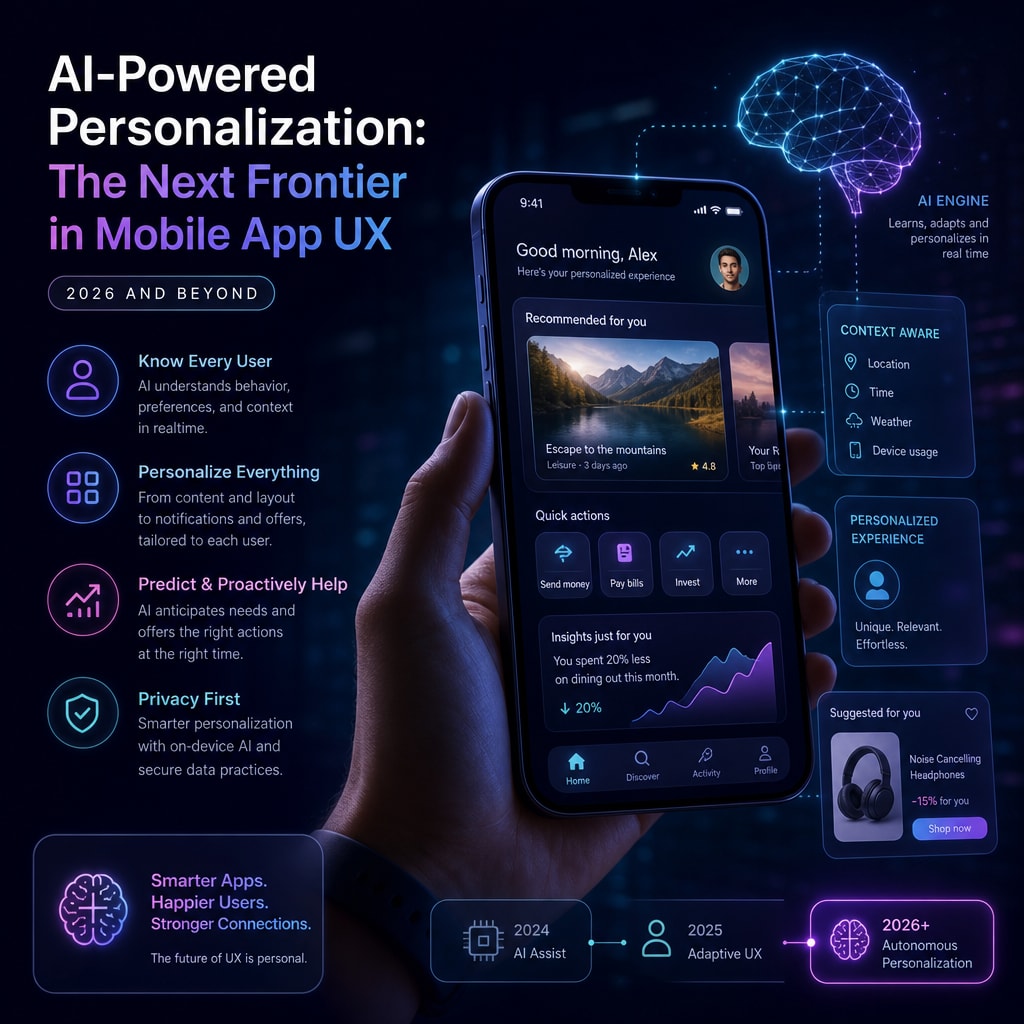
Users no longer want to experience generic mobile experiences in 2026. They want apps to know them; sometimes even more than they know themselves. AI-powered personalization has evolved beyond basic recommendations to contextually relevant and adaptable user experiences, driving this transformation.
Whether it's reshaping interfaces as people go through them or anticipating their needs, AI is changing the game for mobile UX. We will examine the present status of this technology, trends, its impact in the real world, obstacles and how innovative businesses can take advantage of this technology.
The Evolution of Personalization in Mobile Apps
Traditional personalization was based on simple principles: “People who purchased X also purchased Y.” Today's AI systems are more powerful.
They observe behavioural patterns, contextual cues (time of day, location, emotional states, device usage), interactions from the past and even biometric data, with consent, to provide hyper-personalised journeys.
It is now commonplace for people to expect hyper-personalization in 2026, not a luxury. An app which is not adaptable seems outdated and loses user attention.
Key Trends Shaping AI-Powered Personalization in 2026
- Adaptive Interfaces & Dynamic Layouts
AI now transforms whole screens according with user behavior. Employed features appear at the top, and rarely used appear and move. The navigation, the hierarchy and even the color schemes can be fine-tuned to the user's cognitive load and taste. - Predictive & Contextual Experiences
Apps anticipate needs. If the fitness application recognizes a high level of stress, it could recommend a de-stress session that runs in the evening.For example, if the fitness application detects a high level of stress, it can recommend a de-stress session that is scheduled for the evening. A weather, event or past shopping history based reordering of product displays can be made using a shopping application.
- Conversational & Multimodal UX
Natural language interactions, voice commands and AI assistants are becoming more human. The users will be able to pose complex questions and get a response tailored to each user based on their past and objectives. - On-Device AI Processing
On-device models, such as Apple Intelligence, Google Gemini Nano, and others, are accelerating the progress of privacy-enhancing personalization with low latency. Super-sensitive data remains on the phone, but still provides a strong personalisation.
- Emotional Intelligence in Apps
Interactive patterns are recognized by advanced models to detect user frustration, user delight, or user boredom, and affect the tone, pacing, or suggestions.
Benefits, Challenges, and How to Implement AI Personalization
- Higher Engagement: Apps with strong AI personalization report up to 62% higher engagement rates.
- Improved Retention: Personalized experiences can significantly reduce churn by making users feel the app was built just for them.
- Better Conversions: Relevant recommendations and contextual offers drive higher purchase rates.
- Enhanced User Satisfaction: 71% of users are more likely to engage with apps that offer personalized features.
Businesses implementing these systems see measurable ROI through increased session times, feature adoption, and lifetime value.
Challenges & Considerations
While powerful, AI personalization comes with responsibilities:
- Privacy Concerns — Users demand transparency and control over their data.
- Algorithmic Bias — Poorly trained models can create unfair or irrelevant experiences.
- Over-Personalization — Too much customization can feel creepy or overwhelming (“filter bubble” effect).
- Technical Complexity — Building scalable, secure, and performant systems requires expertise.
- Regulatory Compliance — GDPR, CCPA, and emerging AI regulations must be respected.
How to Implement AI-Powered Personalization (Practical Advice)
- Start with clear user value and obtain explicit consent.
- Combine on-device and cloud AI for the best balance of privacy and capability.
- Use tools like FlutterFlow, custom ML models, or platforms with built-in personalization engines.
- Test extensively with real users and monitor for bias.
- Focus on “helpful” rather than “creepy” — always add value.
The Road Ahead (2027 and Beyond)
Looking forward, we’ll see even more seamless integration of generative AI, emotional AI, and augmented reality personalization. The most successful apps will feel less like tools and more like intelligent companions.
Conclusion
Personalizing mobile app UX with AI is no longer a luxury, but a must-have to stay competitive. With careful planning and implementation, businesses can foster greater user connections, loyalty, and enduring development by embracing it.
We aim to help you create intelligent and personalized mobile experiences that are going to stand out in 2026 and beyond at Davidayo.
Looking for a way to create your app to the next level? Talk to us today to schedule a consultation for personalized strategies with AI for your mobile app.