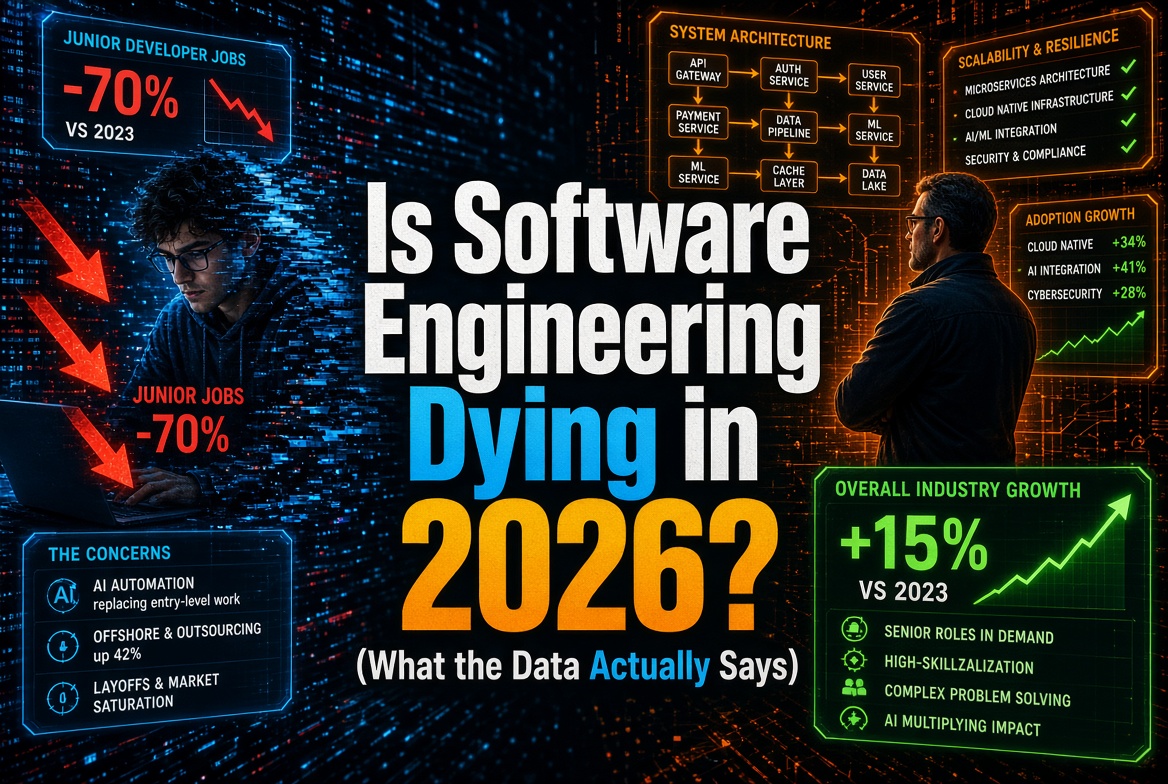
There is a lot of noise online right now about whether software engineering is a dying profession. Between headlines claiming junior developers are "cooked" and a shifting job market, it's easy to feel anxious. But if you look past the panic and examine the actual data, a very different picture emerges.
What the Data Actually Says
Recent data from Stanford and the U.S. Bureau of Labor Statistics tell a nuanced story:
- The Junior Dip: Junior developer job postings dropped significantly from 2022 peaks, and employment numbers for developers aged 22–25 saw a contraction during that same window.
- Long-Term Growth: Despite the entry-level crunch, the Bureau of Labor Statistics still projects roughly 15% growth for software developers over the coming decade—about 5 times the cross-industry average.
The work hasn't vanished; it has shifted upward. AI models have largely automated the routine coding tasks that used to fill the entry-level "bottom rung"—such as writing basic boilerplate, simple CRUD apps, test scaffolding, and routine bug fixes.
4 Essential Focuses for Developers Today
To thrive in this environment, developers need to adapt their skillsets away from writing basic code and toward higher-leveraged engineering capabilities:
1. Own Systems, Not Just Lines of Code
Writing individual functions or snippets is now cheap and fast. What companies actually pay for is deep architectural comprehension—understanding data flows, trade-offs, potential failure points, and making defensible design choices. Focus heavily on system design, debugging production environments, and navigating complex codebases.
2. Supervise AI Tools Like a Professional
Avoid "vibe coding" (blindly accepting and shipping whatever an AI model outputs). Treat AI coding assistants like exceptionally fast but junior partners: review every line, write robust tests, and never merge code you cannot personally explain.
3. Build the AI Layer Into Products
One of the fastest-growing sectors involves shipping software with integrated AI features. This means getting comfortable managing model APIs, structuring outputs, setting up RAG pipelines with vector databases, and orchestrating intelligent agents.
4. Build and Ship Real Proof
Passive tutorial watching yields low retention. Actively building, deploying, and maintaining your own production software serves as definitive proof of competence to modern employers.
Conclusion
The narrative that software engineering is dying in 2026 is fundamentally misguided. While the entry-level market has tightened significantly as AI handles repetitive coding tasks, overall industry growth remains strong. The profession isn't disappearing—it is evolving. Developers who move beyond basic syntax writing to master system architecture, critical AI supervision, and product-level integration will find themselves more valuable than ever.
Frequently Asked Questions (FAQs)
1. Is software engineering still a good career choice in 2026?
Yes. While entry-level competition is fierce and junior job postings have dipped from their 2022 peaks, the U.S. Bureau of Labor Statistics still projects substantial growth for software developers over the coming decade, vastly outpacing the cross-industry average.
2. How has AI changed entry-level developer jobs?
AI models have largely automated routine entry-level tasks like boilerplate generation, basic CRUD app creation, and test scaffolding. Consequently, companies are shifting away from hiring pure "code writers" and are instead looking for engineers who possess strong system design and problem-solving skills.
3.What skills should I learn to stay competitive?
Focus on mastering system architecture, debugging complex production codebases, developing with AI tool integration (such as RAG and agent workflows), and critically reviewing AI-generated code rather than blindly accepting it.