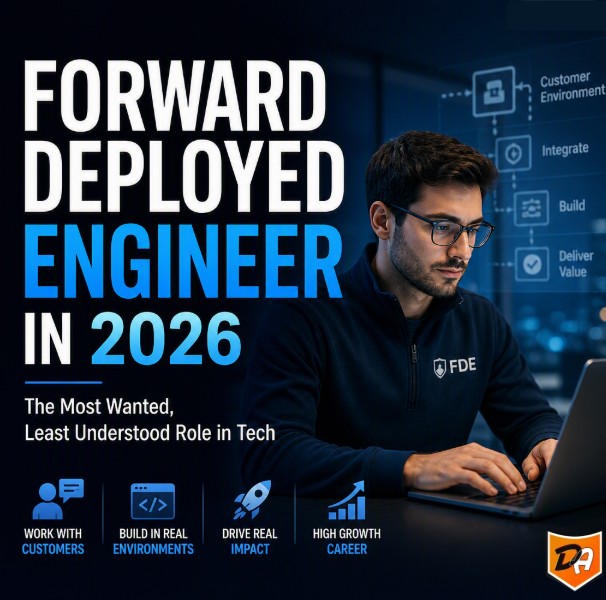
Introduction: The Most Wanted, Least Understood Role in Tech
There is a role in tech right now where mid-level engineers are making $300K to $400K+, job postings have grown over 1,165% in a single year, and most developers have never even heard of it. It's called a Forward Deployed Engineer (FDE), and tech giants like OpenAI, Anthropic, Google, and Palantir are fiercely competing for the tiny pool of talent capable of doing it.
Unlike high-level PhD research roles, the FDE skill stack is composed of practical tools that a solid developer can master quickly. When stacked together, this combination creates an extremely rare and lucrative profile.
What is a Forward Deployed Engineer?
Pioneered originally by Palantir, the FDE role was born out of necessity: their software was powerful, but incredibly complex. Instead of shipping software remotely and hoping for the best, Palantir embedded engineers directly with customers.
Today, every enterprise AI company faces a major bottleneck: AI demos work brilliantly, but struggle when they meet the real world—legacy systems, messy client data, strict compliance rules, and internal friction. An FDE lives right inside that gap. You write production code inside the customer's environment, effectively wiring AI products into their core systems until they deliver tangible business value.
It's a hybrid role combining:
- Part Engineer: Building data pipelines and production integrations.
- Part Consultant: Explaining what AI can and cannot do to executives.
- Part Product Owner: Owning real-world deployment outcomes and fixing production issues under pressure.
Why Demand Exploded in 2026
The bottleneck in tech is no longer the models—the models are exceptionally powerful. The bottleneck is the messy reality of getting them into production systems that impact corporate workflows. Because companies are willing to pay top dollar to solve this, FDE roles have surged, with New York emerging as a major hub due to high demand in fintech and regulated industries.
The Three-Part FDE Skill Stack
Landing an FDE role requires mastering three core skill buckets. Most developers only possess the first, creating the career gap and massive salary potential:
- Real Software Engineering: Strong foundational Python, API development and consumption, databases, SQL, testing, debugging, and system design.
- AI Fluency: Building with LLM APIs, prompt engineering, structured outputs, RAG (Retrieval-Augmented Generation), vector databases, and agent orchestration.
- Customer & Soft Skills: The ultimate differentiator. You must be able to translate vague business problems into technical execution plans, communicate technical concepts in plain business language, and take full ownership when things break.
A Fast-Track Action Plan to Get Hired
- Build Deployment-Style Projects: Move away from generic to-do list apps. Solve real-world, messy problems for local businesses or colleagues by building custom RAG or agentic systems, deploying them, and measuring tangible impact (e.g., cutting turnaround times from days to minutes).
- Collect Customer Repetitions: Actively volunteer to run client demos, sit in on requirement-gathering sessions, and present ideas to non-technical teams to sharpen your communication muscle.
- Target the Right Doors: While major AI labs are hyper-competitive, hundreds of smaller AI companies are hiring FDEs right now with significantly less friction. Gaining 1–2 years of experience here serves as an ideal launchpad.
Cracking the FDE Interview
FDE interviews deviate significantly from traditional LeetCode-heavy engineering loops. Expect roughly five stages over 3 to 6 weeks, featuring an ambiguous case study where a hypothetical customer hands you a vague problem to decompose on the spot. Success in these loops relies heavily on your judgment, your structured communication (using frameworks like STAR), and your ability to clarify requirements before diving into code.