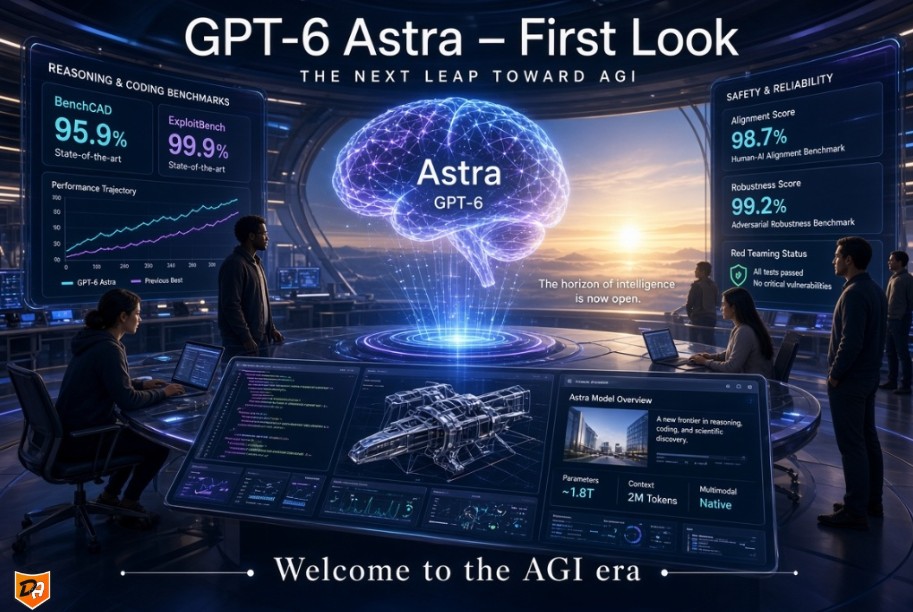
OpenAI has not officially declared that it has proved artificial general intelligence (AGI). Instead, the company presents GPT-6 Astra as the first model that might mark the start of an "AGI era," citing dramatic capability jumps and a new "critical" cybersecurity status. Whether Astra truly meets academic or industry definitions of AGI remains an open question.
1. How OpenAI Frames Astra's Relationship to AGI
Recent media briefings and executive statements have positioned GPT-6 Astra right at the boundary of next-generation intelligence. Here is how major industry coverage breaks down the narrative:
| Source | What OpenAI Says | Nuance / Caveat |
|---|---|---|
| Axios | "Welcome to the AGI era" – co-founder Greg Brockman suggested Astra could be the model that marks AGI's arrival. | Brockman also noted that AGI is a "gray, fuzzy thing" and the claim is left to users to judge. |
| VentureBeat | Astra "likely marks the onset of artificial generalized intelligence (AGI)". | The statement comes from a press briefing, not a formal contractual trigger. |
| The New Stack | Brockman said it's "not unreasonable to feel that we are now in the AGI era." | He qualified that the term is now a "mission concept or spiritual concept," not a legal definition. |
| Forbes | CEO Sam Altman expects an internal AGI system by year-end 2026; Astra is described as the first model that "invent[s] new things in a way that matters." | Altman's forecast is forward-looking; Astra itself is still being evaluated. |
Take-away: OpenAI positions Astra as a potential AGI milestone, but explicitly acknowledges that AGI is still debated and no formal declaration has been made.
2. Core Technical Capabilities (First-Look Demos)
Beyond the executive marketing and PR framing, the early technical capability benchmarks highlight why Astra is stirring conversation across the AI community:
- Autonomous Problem Solving: Demonstrated capacity to execute multi-step workflows without constant human feedback loops.
- Novel Synthesis: Moving past pure pattern recitation into creative generation and structural reasoning.
- Enhanced Security Classification: Triggering elevated internal cybersecurity evaluations due to its autonomous execution bounds.
3. Benchmark Performance (Quantitative "First Look")
These numbers show order-of-magnitude improvements on specialized AGI-oriented benchmarks, especially when Astra is run with its stateful "Responses API" harness that retains reasoning across turns:
| Benchmark | Astra Score | Comparison | Time / Efficiency |
|---|---|---|---|
| OSWorld 2.0 (offline subset) – agentic desktop tasks | 72.6% | GPT-5.6 Sol: 65.7% | ~40 min per task vs. ~75 min for Sol (~47% faster) |
| ARC-AGI-3 – abstract-reasoning | 98.6% (stateful harness) – reported as 99.9% under OpenAI's provider-adapter harness | GPT-5.6 Sol: 7.8% (stateless) | — |
| FrontierMath Tier 4 – hard math | 97.6% (saturates the tier) | — | — |
| ExploitBench – cybersecurity exploits | 100% | — | — |
| Long-context tests (MRCR v2 256K-512K) | 100% (8-needle) and 96.3% (512K-1M) | 91.5% / 73.8% for Sol | — |
4. Safety, Alignment, and Cybersecurity Status
- Critical Cybersecurity Threshold: Astra is the first OpenAI model flagged as "critical," meaning it can discover and exploit previously unknown vulnerabilities without step-by-step human guidance.
- Safety Testing Delay: Release was slowed to add extra safety checks after the cyber-capability assessment.
- Chain-of-Thought Monitoring: Chief Scientist Jakub Pachocki notes that OpenAI watches Astra's internal "scratchpad" to catch unsafe reasoning.
- Alignment Focus: OpenAI describes Astra as its "most capable and most aligned" model, featuring an experimental mechanism that maintains notes across context windows and asks clarifying questions without halting execution.
5. Compute Resources & Rollout Plan
- Training Compute: Built on OpenAI's largest-ever run, utilizing over 100,000 GPUs at the "Stargate" data center in Texas.
- Release Schedule: Rolling out first to a limited set of companies in the Daybreak cybersecurity program, followed by enterprise customers, then ChatGPT Plus, Pro, and Business plan subscribers. Availability for free-tier users has not yet been announced.
6. Internal Viewpoints on "How Close to AGI"
| Person | Quote / Claim | Context |
|---|---|---|
| Greg Brockman (President, co-founder) | "I think it might be about this model… Welcome to the AGI era." | Press briefing, acknowledging the claim is subjective. |
| Sam Altman (CEO) | Expects an internal AGI system by late 2026; calls Astra a step toward that goal. | Customer preview, forward-looking. |
| Mark Chen (Chief Research Officer) | "We're 80% of the way" to AGI. | Internal assessment (reported by Forbes). |
| Jakub Pachocki (Chief Scientist) | Astra meets the internal benchmark for an "automated AI research intern." | Describes capability to design, run, and interpret experiments. |
These statements show strong confidence within OpenAI, but they are projections or internal metrics rather than formal external verification of AGI.
7. Bottom Line – Did OpenAI Actually Build AGI?
- No Definitive Proof: OpenAI has not presented an independent, universally accepted test proving that Astra matches or exceeds human performance across most economically valuable tasks (the standard working definition of AGI).
- Strong Evidence of AGI-like Behavior: Astra’s agentic computer use, record-breaking scores on AGI-focused benchmarks, and autonomous capabilities in software environments are unprecedented for a commercial model.
- OpenAI’s Stance: The company frames Astra as potentially the first model that could be labeled AGI, while openly admitting that "AGI remains a gray, fuzzy thing."
Conclusion
Astra is a massive step toward AGI, but whether it crosses the threshold into true AGI remains an open and heavily debated question.