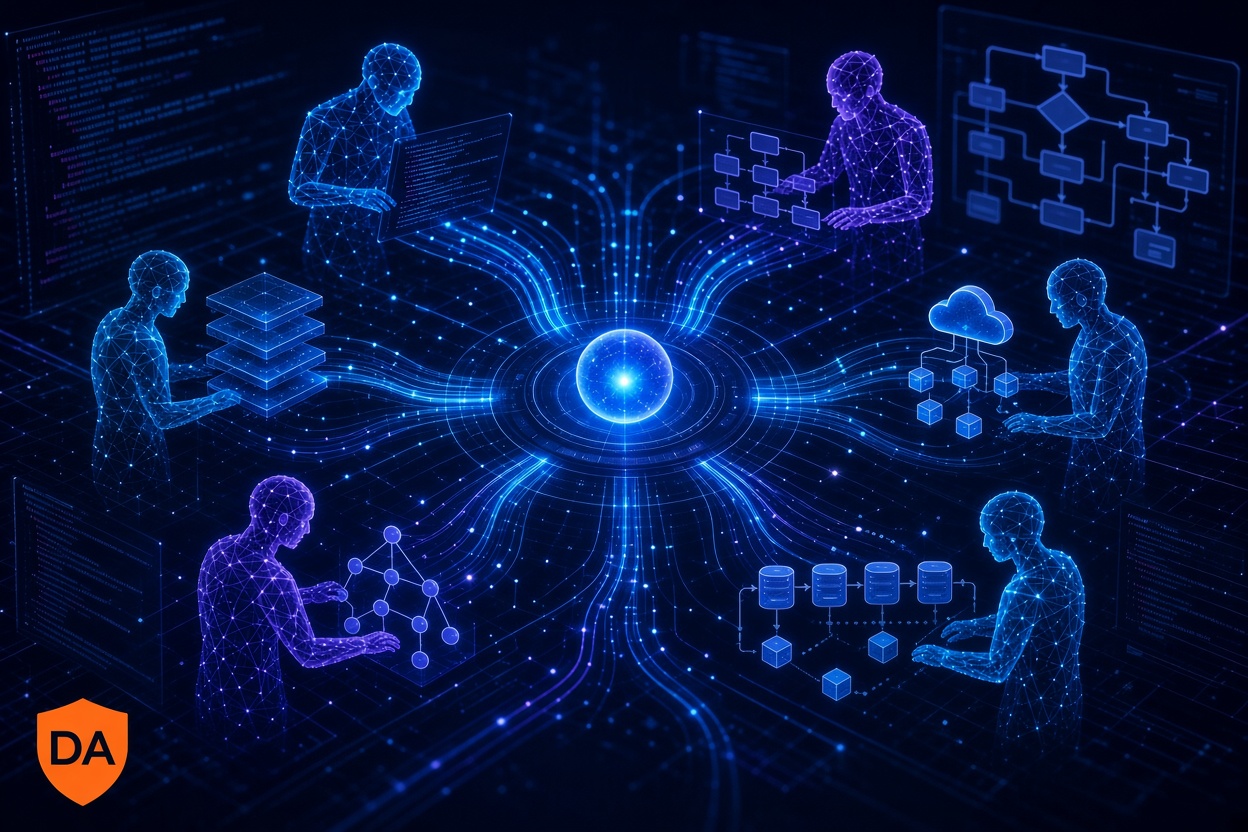
Software development is changing fast. We're moving well past traditional workflows and basic coding assistants into the era of AI agents—autonomous, goal-driven systems that do a lot more than just handle repetitive chores. They're actually reshaping how software gets dreamed up, built, and kept alive. The result is a Software Development Lifecycle that feels far more adaptive, fast-moving, and iterative than anything we've had before.
What are AI Agents and Why Orchestration Matters?
Unlike conventional AI tools that offer one-step solutions or respond to individual prompts, AI agents are sophisticated entities capable of performing multi-step tasks, reasoning, making decisions, and interacting with other systems to achieve a defined goal. They act as intelligent partners, augmenting human potential rather than replacing it.
The true power, however, lies in AI agent orchestration. This practice involves coordinating multiple specialized AI agents to work collaboratively on complex, multi-step tasks that a single agent cannot handle alone. An orchestration layer manages the state, communication, and execution flow across these agents, assigning specific tasks based on their specialization and coordinating handoffs between them.
The benefits of this multi-agent approach are significant:
- Specialization and Context Isolation: Each agent can focus on a specific job (e.g., planning, coding, testing), receiving only the relevant tools and context, which prevents confusion and improves accuracy.
- Practical Speed: Different specialized agents can work in parallel, such as frontend and backend development, significantly cutting down development time for complex projects.
- Cost Efficiency: Routine or less complex tasks can be routed to smaller, more cost-effective models, while complex reasoning is handled by more powerful, specialized models.
AI Agents Across the SDLC Phases
AI agents are being integrated across the entire software development lifecycle, moving past simple coding assistants to transform every phase from initial requirements gathering to ongoing maintenance:
- Planning and Analysis: Agents assist in establishing project goals and scope, collecting requirements, and analyzing information. They can analyze legacy code to autogenerate baseline requirements, freeing human experts to focus on core innovation.
- Design: AI contributes to defining project architecture, generating multiple UI/UX prototypes aligned with brand guidelines, and simulating load and security scenarios before coding begins.
- Coding: Moving beyond simple autocompletion, agents automate code generation, documentation, and refactoring. They write production-grade code, self-optimize pipelines, and review pull requests to identify security vulnerabilities and performance bottlenecks.
- Testing: AI agents revolutionize quality assurance by automatically creating unit, integration, and regression tests. They detect runtime anomalies, perform visual regression testing, and uncover edge cases for faster feedback loops.
- Deployment and Maintenance: AI streamlines CI/CD pipelines by predicting bottlenecks and automating routine deployment checks. In maintenance, intelligent monitoring systems analyze logs in real-time to detect failures and apply automated fixes.
The Shift in Human Roles: From Coders to Conductors
Crucially, the rise of AI agents does not signal the replacement of human developers. Instead, agents act as an intelligent layer that significantly enhances productivity, reduces cognitive load, and improves decision-making. The role of the human developer is evolving from manual code writing to becoming a supervisor, designer, and maintainer of these agentic systems.
Senior engineers and developers are increasingly focusing on higher-level architecture, strategy, system design, and critical review. This elevates developers into strategic positions where their judgment, ethical oversight, and ability to design systems where people and agents collaborate safely become paramount.
Challenges and Considerations for the Agentic SDLC
While the productivity gains are compelling, adopting an agentic SDLC comes with unique engineering challenges:
- Governance and Security: Establishing robust governance frameworks is crucial to ensure agents operate within ethical boundaries, comply with security protocols, and protect data privacy.
- Complexity of Orchestration: Managing interactions, seamless communication, and error handling across multiple specialized agents requires architectural discipline.
- Debugging and Explainability: Tracing the root cause of an unexpected result across interacting autonomous agents can be difficult, making model explainability essential for trust.
- Integration with Legacy Systems: Safely embedding AI agents into existing enterprise codebases requires careful planning to prevent workflow disruption.
- Skill Gap: Developers must continuously adapt by learning prompt engineering, agent architecture design, and automated workflow governance.
The Future is Collaborative and Agent-Driven
The orchestration of AI agents is a fundamental paradigm shift in software engineering. It promises an SDLC that is dynamic, responsive, and capable of delivering high-quality applications at unprecedented velocity. As these frameworks mature, the synergy between human creativity and orchestrated AI workflows will define the next era of tech innovation—allowing developers to focus entirely on visionary problem-solving while intelligent agents handle complex execution.
FAQ
What is AI agent orchestration in software development?
AI agent orchestration is the practice of coordinating multiple specialized AI agents so they work together on complex engineering tasks. Instead of using a single AI coding assistant, teams manage a group of agents that can plan, write code, test, debug, and even help with deployment in a structured workflow.
How is agent orchestration different from regular AI coding tools?
Traditional AI coding tools (like GitHub Copilot or ChatGPT) mainly help with writing or completing code. Agent orchestration goes further by giving multiple agents defined roles, memory, tools, and the ability to hand work off to each other. This allows them to handle multi-step processes with less constant human input.
Does AI agent orchestration replace developers?
No. It changes the nature of the work. Developers spend less time writing routine code and more time on architecture, system design, reviewing AI output, setting goals for agents, and making critical decisions. Human judgment remains essential for quality, security, and product direction.